Wednesday, 16 March 2022

Birding Around Mock Exams: Part 1

From the 21st of February to the 4th of March I had my second lot of mock exams of year 13. Revision and cracking down on the hard work has kicked in now for my A Levels in May and June, so I've had to take a slight step back from birding so regularly, and this is also the reason for the long gap between blog posts. Either side of my mock exams I still managed to enjoy some quality birding moments.

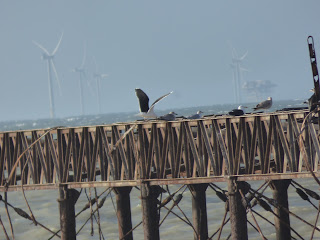
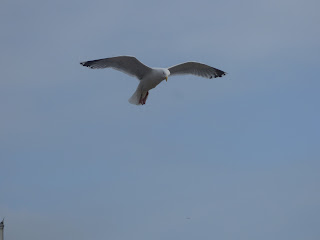
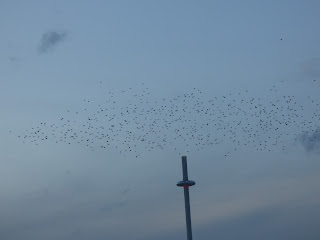
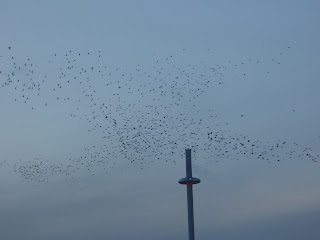
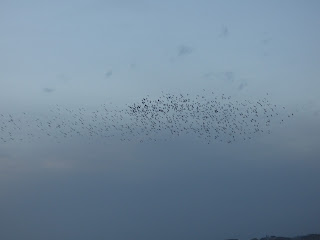
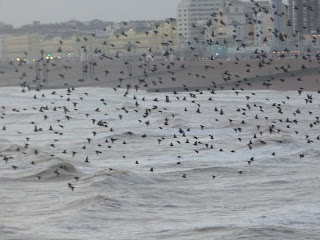
On the 16th and 17th of February I went down to Brighton to see the Starling murmuration at Brighton Palace Pier. I had been exactly 2 years ago on the same dates and had wanted to visit again. The raging stormy weather on the first night unsurprisingly meant that the Starlings did not put on a show, quickly taking shelter beneath the structure of the pier. I didn't leave the shelter on the hotel and viewed the pier from the window. As a result, instead of heading home on the Thursday morning, I decided to stay in the area and wait until dusk for another try with the Starlings. A pleasant walk along the coast to Shoreham provided a lifer in the form of the long-staying Long-tailed Duck that had been at Southwick Ship Canal since November. I had actually somehow missed all the reports of this bird on Birdguides, so it was an awesome surprise to see it.

Ebird trip report here.

Some pics from my time at Brighton:

Partially leucistic male Blackbird

Stormy Brighton
Stormy conditions

Great Black-backed Gulls
Great Black-backed Gulls and Herring Gulls (plus a Cormorant on far right)

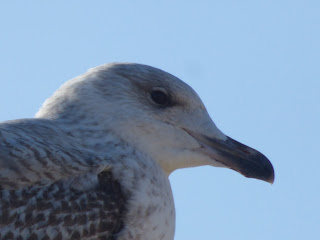
1st winter Herring Gull

1st winter Herring Gull
The same 1st winter Herring Gull as the individual above

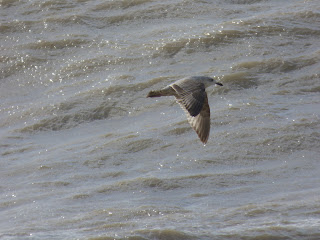
1st winter Herring Gull flying
1st winter Herring Gull

1st winter Herring Gull flying
1st winter Herring Gull

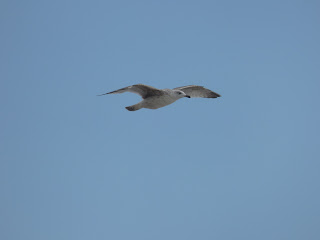
Herring Gull flying
(2nd winter?) Herring Gull

Pied Wagtail

Pied Wagtail above and below

Pied Wagtail


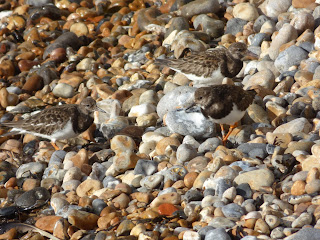
Turnstones

Turnstones above and below

Turnstone

Turnstone
Turnstone showing off its retrices

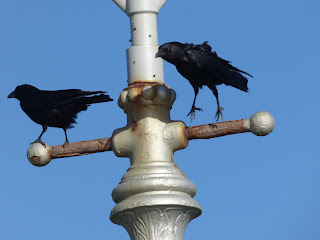
Carrion Crows

Carrion Crows above and below

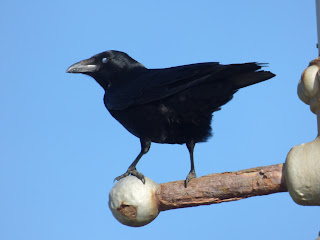
Carrion Crow
Showing off its nictitating membrane

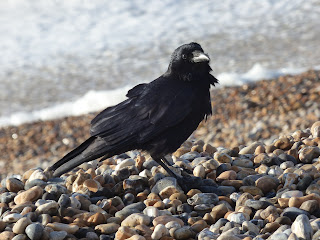
Carrion Crow
I quite liked the lighting on this one

Starling
Iridesence showing nicely on this Starling 

Female Long-tailed Duck

Female Long-tailed Duck above and below - I'm still confused by the age of this bird. Reviewing online pictures of this individual, perhaps a 1st winter bird that's mantle has become less contrasting as it has matured through the winter and started to look more adult-like? For anyone with more knowledge about Long-tailed Duck moult patterns and how to age them any opinions would greatly be appreciated.

Female Long-tailed Duck

Peregrine
Peregrine

Sinensis Cormorant
Cormorant (sinensis subspecies)

Orange ringed 'F0TT' Herring Gull below:

Ringed Herring Gull

Ringed Herring Gull

Ringed Herring Gull

Ringed Herring Gull

Ringed Herring Gull

Ringed Herring Gull

Ringed Herring Gull


3rd winter Herring Gull flying
3rd winter Herring Gull

Adult Common Gull flying
Adult Common Gull

1st winter Herring Gull flying
1st winter Herring Gull

Herring Gull flying
(3rd winter?) Herring Gull


Brighton Pier

Starling murmuration below:

Starling murmuration

Starling murmuration

Starling murmuration

Starling murmuration

Starling murmuration

Starling murmuration

Starling murmuration


Wednesday, 16 February 2022

Wet and Windy at Rainham Marshes

Yesterday I met up with Ben Rumsby for a spot of birding at Rainham Marshes in Essex. Rain and strong winds were forecast for most of the day and conditions were tricky. Despite this, I still managed to get 66 species for the day with a lot of help from Ben, 7 of which were new for me at Rainham - taking me from 96 species to 103 (not bad considering how infrequently visit).

The day started well. Before Ben arrived I decided to walk along the river to Aveley Bay in the hopes of seeing a few flocks of waders. Almost instantly I heard 2 Rock Pipit calling and picked them up in flight as they went further along the river bank. They were my first ever Rock Pipits at Rainham (that I have been able to identify) and a welcome sight considering how few records there are each year at Beddington. A bit further along the river wall a Curlew showed nicely and 18 Shelduck were out in the bay. Several Teal and Wigeon had also collected on the Thames, whilst a few Common Gulls and Great Black-backed Gulls flew west. Wigeon are annual but scarce at Beddington and numbers are never very high, whilst large numbers of Teal are mostly hidden from public view. Over 1,000 Lapwing erupted into the air over the reserve, which was clearly the impact of a bird of prey. It didn't take long to find that a female Peregrine had caused the mass panic - a first for me at Rainham. About 10 minutes later a male had taken over and a Marsh Harrier added to the chaos. However, after scanning and being rather disappointed by the absence of any Black-tailed Godwits or Avocets in Aveley Bay, I turned around to head towards the Visitor Centre where I planned to meet Ben. About half way back a flock of 5 Redshank called loudly as they took off from the river bank, whilst 3 Dunlin burst over to the Kent side (another Rainham first for me).

Curlew
Curlew

Male Wigeon
Male Wigeon

Lapwings
Lapwings

Female Peregrine
Female Peregrine

Redshank
Redshank

After meeting at the Visitor Centre, we made hasty progress around the reserve. Not much of particular interest was about and we were heading towards where the long-staying Spoonbill had been regularly seen. Before we even got there, we spotted the Spoonbill (my 4th Rainham tick of the day already and species 100!) in flight as it dropped down onto a part of the reserve that we would struggle to view from the upcoming hide. Nonetheless, it was a decent view and it's only my 3rd ever Spoonbill anywhere. Once we got to the Shooting Butts hide, a Water Pipit showed well - far better than the often fleeting views back at Beddington - in front of a Common Snipe. Several more Snipe were spotted whilst scanning along the edge, but sadly none could be morphed into a Jack Snipe.

Rainham is still the only place I have ever seen Ruff, but unfortunately the two that had recently been seen were not present on Target Pools when we got there. There were also no Avocets or Godwits, so we quickly moved on and headed off towards Serin Mound. Being my first time up there, I was impressed by the views it provided over the reserve. However, the 5 Barnacle Geese that have been staying on Wennington sadly were not seen. We then headed back to the Visitor Centre for midday. More Redshank and Dunlin flew out from the reserve towards the river.

We stayed for a good two and a half hours in the centre before Ben left. Whilst there, a Fieldfare and a couple of Redwing occupied the ground around the feeders, whilst a pair of Long-tailed Tits and some Chaffinch fed above them. Curlews flew close to the windows as they went out to the river to feed. Ben managed to pick out an adult Mediterranean Gull flying east along the far bank of the river. That put me up to 5 new Rainham birds for the day. The Spoonbill had also decided to go over to the far river bank.  Ben also spotted an Oystercatcher (my 6th Rainham tick) and 4 Avocet swimming on the river. I also finally met Howard Vaughan for the first time - an excellent birder and naturalist that helps out at Rainham a lot. I had heard good things about him from other young birders already. We chatted for a while about different birding experiences and he shared some of his knowledge too. Ben then left at 14:30 and I headed back out into the rain to do one more circuit around the reserve before heading home.

A quick stop in the Purfleet hide provided nice views of a drake Pintail. Beddington had no male Pintail last year so I enjoyed watching this stunning duck. A couple of Redshank also put on a show by flying and calling close to the hide. The walk from there to Target Pools provided good views of a female-type Marsh Harrier, a male Pheasant, and quick glimpse of a calling Bearded Tit. There were still no waders on Target Pools, except for about 10 Lapwing. However, I managed to pick up an adult Yellow-legged Gull flying straight towards me. On the way back to the Visitor Centre, I managed to get a male Firecrest nice and close, which was an excellent way to finish the day as it was another first for me at Rainham.

Redshank sound recording:


Male Pheasant
Male Pheasant

Adult Yellow-legged Gull flying
Adult Yellow-legged Gull - the mantle was noticeably darker than that of Herring Gulls when I picked it out and in this pic the broad black band on p5 can be seen and there are no white tongue tips on p6 or p7. There is only a small grey tongue on p8

Male Firecrest
Record shot of the male Firecrest in the fading light of what was already a dark and grey day

Firecrest sound recordings:


An excellent day overall (full Ebird list here) and I look forward to visiting again at some point in the not too distant future. Perhaps a day during spring migration might be a plan?

Sunday, 13 February 2022

Day out at Reigate

After seeing multiple reports of a large flock of Brambling just outside of Reigate, I decided I could not resist and yesterday I finally headed out to see them. It was a rather pleasant day: a bit chilly but still fairly sunny and some nice blue sky at times. Whilst changing trains at Redhill Station, a lovely Pied Wagtail entertained me for the otherwise tedious 20 minute wait. It was very tame and was not bothered by me one bit. I wonder whether it may nest somewhere within the vicinity of the station.

Once I got off the train, rather than going straight to see the Bramblings at Clifton's Lane, I went towards Reigate Park to see the long-staying adult female Ring-necked Duck on Priory Pond. Seeing as this species was a lifer I thought it would be silly of me not to get it whilst I was in the area. The pond was larger than I expected based on descriptions I had heard, but it was still interesting to note the number of different birds present - Shoveler, although expected from looking at the Ebird hotspot in advance, were nice to see. Wigeon had also been reported to be present recently on Ebird but unfortunately I did not see any. The Ring-necked Duck was actively feeding at the back centre of the pond with 3 male Tufted Ducks. After snapping a few pics, I walked around the pond to see if I could get a little closer. However, by the time I did, it had swam towards where I initially stood.

Adult female Ring-necked Duck and male Tufted Duck
Adult female Ring-necked Duck with a male Tufted Duck

Instead of chasing it around the pond, I decided to ascend the hill that was behind me. I wondered what the view at the top looked like and the woodland looked like good habitat for some smaller birds. About three-quarters of the way to the top of the hill there was a lot of bird activity. There was a noisy flock of Blue Tits and Great tits (about 10 of each), with a Coal Tit mixed in. In with their noisy calls, I could here a quieter call that made me think of Marsh Tit. I've never knowingly seen or heard one before and I was not totally confident. I reached for my sound recorder and managed to get around 40 seconds of audio. I could just make out which bird the sound was coming from flitting around in a tree in front of me, but did not manage a view good enough to notice any features - smaller than the Great Tits is the best I could do. Thankfully, a later check confirmed that the suspect call was detectable in the sound recording, despite being drowned out a bit by the closer Blue Tits. I sent it to Arjun to ask for his thoughts and to my delight he came back and said that it sounds good for a Marsh Tit. So technically my second lifer of the day but with the poor views and still a chance of Blue Tit mimicry I would like to go back some time and confirm fully. Any opinions on this call are welcome in the comments as it is all part of the learning process for me.

The walk from Reigate Park to Clifton's Lane was also very enjoyable, despite there being less birds about. However, once I arrived at Clifton's Lane, I was greeted by three Feral Pigeons as I walked under the railway bridge where they had noisy chicks and from there onward the birding picked up again. It did not take long to locate the 204 strong Brambling flock as they whirled around the field and perched in the bordering trees that I was heading towards. I carefully crept up on the flock, being careful not to spook them. I managed to get a few pics of some birds perched in the branches above my head. I was surprised by how quiet the flock was. Only the odd call was uttered from time to time, with a Linnet joining in too. However, that changed very quickly. All of a sudden the entire flock exploded out of the trees and flew further in to the wooded area surrounding the field, calling loudly as they went. At first I thought it was due to the cyclist that coincidentally raced past at that moment, but it was in fact as a result of the Sparrowhawk that had come swooping in for some early dinner. It was unsuccessful and so repeatedly came back for another go, which added to the spectacle of the finch flock as they rapidly twisted and turned to avoid predation. It also provided the perfect opportunity to attempt to get a few shots of the Bramblings in flight.

Bramblings below:

Brambling

Brambling

Bramblings flying

Bramblings flying

Bramblings flying

Other highlights from Clifton's Lane include: a heard only Red-legged Partridge (Surrey tick), 2 calling Pheasants, a Siskin flying west (shockingly my first of 2022), a pair of Buzzards, and a Red Kite. On the walk back to the station another Red Kite drifted slowly over Reigate Castle. So overall a very good day indeed. Ebird trip report here.