Spring at Beddington Farmlands has at times felt very slow this year and overall been a bit underwhelming. However, I have still had some quality birding moments since my last blog post. So here's a summary of the highlights from April...
8th April:
The first Reed Warbler, Sedge Warbler and Whitethroat of the year were all found by 10:15. Dodge, Glenn and I heard a Cuckoo a few times, which unfortunately Anand did not get as he was too far away. A smart male White Wagtail was out on the southern island of the North Lake.
 |
| Comma Butterfly |
9th April:
Early in the morning I decided to venture all the way into the under-birded depths of the South East Corner. The habitat looks really good for spring migrant passerines to drop in. What I found instead, to my surprise, was a female Cape/South African Shelduck flying around with a male Shelduck. I was drawn to it by it's rather unrecognisable call (it was the first time I had ever seen one, let alone hearing one). I thought it was getting chased off by the male Shelduck, but given that with future sightings I have still never seen it without the male Shelduck, I have come to the realisation that they are indeed paired up. On route back out of the SEC I almost stood on a female Wheatear than was hunkered down in some grass just to the side of the path. I managed a total of 11 Green Sandpipers, 10 Little Ringed Plovers and 9 Cetti's Warblers whilst rinsing the whole site and then headed to my usual vismig point on the mound. I was not staying long, but as Arjun was there I stayed a bit longer despite the quiet sky. But then to our surprise a Curlew flew (silently) low south past us. This was the 4th record for the site this year already - nowadays there are usually only one or two records a year! Even more crazy, this one was exactly a week since the last one and reported only one minute later in the day! Full eBird list here.
 |
| Sunrise |
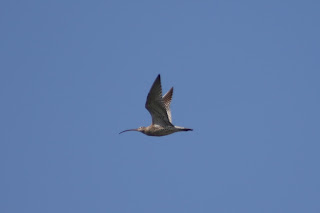 |
| Curlew |
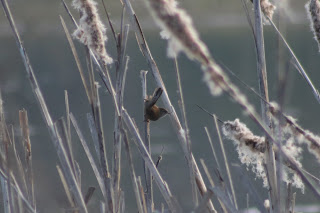 |
| This Cetti's Warbler showed well for Arjun and me on 100 Acre |
10th April:
Dodge and I arrive at the Farmlands late morning for a brief visit to check if anything had been brought in by the rain and wind. We didn't get much but the highlight had to be the row of Swallows lined up on the Phase 3 Wet Grassland fence. It is a sight that we don't often get here and one that is getting increasingly scarcer. Other highlights included 10+ Sand Martin, 6+ House Martin, 1 male Wheatear and a heard only Yellow Wagtail.
12th April:
I hadn't been feeling well so had a day off from my internship/the Farmlands for a couple of days. Of course that's when Arjun found a Yellowhammer on the mound. Once a more regular winter site here, they are now a tricky bird to get. Arjun told me it was hanging around to I tentatively got up and went on the bus to go and see it. I only managed flight views but they were good enough for me so after an hour and a half I got the bus back home and went back to the usual sitting around doing nothing whilst I didn't feel great.
13th April:
Charlie caught a glimpse of what he thought was a Redstart species flush up off the path as he drove by in the vehicle, with Marcus in the passenger seat (we had only just swapped over). He texted me so I headed over to them. They were kindly waiting for me before getting out of the vehicle to minimise the possibility of scaring it away, despite the fact that Marcus had not yet seen it. As I approached them I saw it flick across and I confirmed to Charlie that it was indeed a Redstart species. We waited for a long time but it never really showed itself. I confirmed it was a Common Redstart when it did the briefest phrase of song. Thankfully, Marcus eventually managed to see it and actually got the best view out of all of us and was actually able to see it was a male. Charlie and Marcus went off to do what they were actually planning to do and I waited for longer to see if the Redstart would show any better. I waited through the hail storm and it had still not showed itself again so I decided to head off. My second patch tick in as many days!
14th April:
I was leading a bird walk with Charlie. The Yellowhammer was still hanging around and I managed to see it sat in a tree as well as flight views this time.
15th April:
A fall of 10 Wheatears on the mound doubled my previous high count for the site.
 |
| Male Wheatear |
16th April:
Sunrise above and below
This visually impaired Fox curiously investigated what I was doing whilst at the vismig point:
17th April:
Early morning I found a Whimbrel out on the North Lake. Whilst walking towards my vismig point and getting closer to the Whimbrel I spotted a female Wheatear in a tree at the corner of the North Lake. Once at the vismig point the Whimbrel flew off south before veering east and towards where I knew Charlie was. I called him but he was already onto it as it was vocal. Charlie then found a Golden Plover (2nd record of the year) on Phase 3 so I headed over to him to see that. We were the only two people to see the previous one and later that day Dave came along and reported it had gone so again Charlie and I were the only two birders to see it.
 |
| Female Wheatear |
Whimbrel above and below
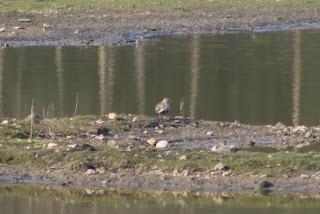 |
| Golden Plover |
18th April:
Charlie and I cleared vegetation off the southern island of the North Lake with a volunteer. A male White Wagtail showed well.
Male White Wagtail below:
20th April:
Duncan Bulling found the first Swifts of the year and later in the day I also saw two.
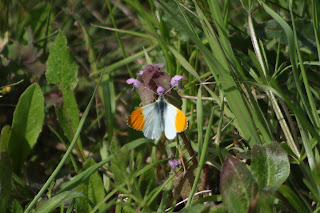 |
| Male Orange-tip Butterfly |
Peacock Butterfly above and below
21st April:
Dodge and I were hoping that the NE wind with an overcast and drizzle would produce the goods and within 15 minutes of arriving we had two adult Mediterranean Gulls circling high above us before continuing south. 50 minutes later and we were beginning to lose our optimism, but a flyover Lesser Redpoll was a welcomed boost, being only the second record for the site for the year at the time. Once I was in the office with Charlie and Dodge had gone home Ian found a Whimbrel, which dropped down onto Phase 3 Wet Grassland. From the window I could see a minimum of 7 Swift and a load of Hirundines. After leaving the office I had a good flock of 17 Yellow Wagtails fly low north over 100 Acre. They continued past the treeline and over towards the golf course/Mitcham Common. 5 Wheatear were on the mound but by the time myself and Dave had got to Phase 3 the Whimbrel had vanished. However, there were a further 11 Yellow Wagtails. A late 1st winter Common Gull circled over the North Lake late afternoon. I ended the day on 72 species and my full eBird list can be seen
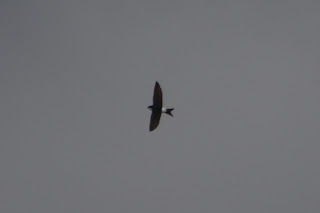
here. In the fading evening light Steve Shimwell and Tomos Brangwyn found a singing Nightingale by the North Lake hide - the same place as the ones on 15/04/20 and 13/04/21. Could it be the same bird using the same migration route each year and just went unnoticed last year?
 |
| House Martin |
22nd:
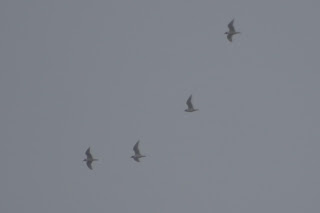
Knowing that it was likely that the Nightingale would still be present in the morning my mum and I made an extra effort to get up and out early, with the aim of getting to the North Lake hide for first light. Rather surprisingly we were actually on track to get there for first light, but just as we were about to get there I got a phone call from Glenn. I somehow knew what he was going to say he had found... a reeling Grasshopper Warbler. It was in a patch of bramble at the west end of Phase 3 Wet Grassland, just inside the perimeter fence. I stood for a minute and debated whether to try for the Nightingale first (a patch tick for my mum) or turn around and go for the Grasshopper Warbler (a lifer for us both). We indeed chose the Grasshopper Warbler and headed back to near where we had walked past only about 5-10 minutes beforehand. As we approached Glenn said it had just gone quiet and played us back (quietly) the tape he had managed to get on his camera. Thankfully, my mum and I did not have to wait too long for it to start up again. Glenn headed off to go and check for the Nightingale whilst we stayed to enjoy the Grasshopper Warbler for a bit longer. It then went quiet for a good 15 minutes so we decided to walk around Phase 3. Only about 50 metres down the path and it started reeling again so I headed back to see if I could catch a glimpse of it whilst my mum continued around Phase 3. Annoyingly, it had now relocated to a denser patch of bramble, which greatly reduced my chances of seeing the bird. If I had waited a little longer originally then perhaps I would have got a fleeting glimpse of it flying between the two bits of bramble. Glenn confirmed that the Nightingale was still present and still singing. Unfortunately by the time my mum and I had got there it had gone silent and was never detected again, even with our return in the evening for one final try. Instead we managed to get onto 4 adult Mediterranean Gulls flying south.
 |
| Adult Mediterranean Gulls |
23rd April:
Charlie and I led a guided walk for the Brighton RSPB group. I had some time to bird the site beforehand. Glenn had already found a male Ring Ouzel and a Fieldfare in the South East Corner as I walking down the road towards the Farmlands. As I got up to the mound upon my arrival to the site I bumped into Anand and Dodge. As I approached them I spotted an Egret flying south above there heads. I pointed it out and then they said it was a Great White Egret. I was obviously not quite awake yet and still had to look at it for quite a while before it sunk in that it was not the usual Little Egret that flies almost the exact same route most mornings. Glenn then found a male Redstart so we all went over to look for it. We were treated to splendid views of it feeding in the trees along the bank of one of the old sludge beds. Given the such poor views of the one Charlie had found me just 10 days prior to this it very much felt like a full patch tick, which indeed it was for Anand. 14+ Wheatear (of which most were females) appeared on the mound during a spell of light drizzle (my new highest count for the site) but unfortunately I had to start heading off to meet Charlie and the RSPB group. Well at least that is what I thought until Charlie contacted me to explain that they were going to be late so I could enjoy some more time with the Wheatears. Just as we started the walk Anand found the first Whinchat of the year and it happened to be just a bit further on from where we all were, so Charlie and I took the group to see it. The typical behaviour of Whinchats perching proudly on vegetation and fences meant that it was a relatively easy bird to point out to people on the walk. Ian and Nick found another Redstart by Mile Road gate.

Male Redstart above and below
 |
| Male Wheatear |
24th April:
I was at home, but Glenn found a pair of flyover Cranes - a patch tick for him. He also found a Garden Warbler (which would have been a patch tick for me)! So I was more gutted about missing the Cranes but the Garden Warbler meant more contextually.
25th April:
Another day away from the Farmlands for me. Glenn had a Tree Pipit and the first Hobby of the year was reported on the Path News WhatsApp group by Russ.
26th April:
I was joining Andy (MKA Ecology) on his survey but first headed to the office. Duncan then found a Garden Warbler along the permissive path so I went to twitch and patch tick that before joining Andy on the survey. As Duncan and I headed towards the South East Corner and towards Andy, a Greenshank flushed up off one of the old sludge beds and towards us, continuing over the mound and away to the north west. Andy and I had a singing Mistle Thrush (a sometimes tricky bird for the Farmlands) in the South East Corner on the border with Beddington Park. After we were done with the survey I headed north to 100 Acre, where I rejoined Duncan. We had a Common and Green Sandpiper together on one of the beds. 2 Hobby glided about amongst the Swifts and Hirundines. Having covered the entire site it was apparent that the Whitethroats had finally had that proper push and had arrived on mass and I ended on a count of 37. On my way out I bumped into Dave at the South Lake hide. He was trying to get his eyes on the loud singing Lesser Whitethroat. It was very close but annoyingly tricky to lock onto as usual. It went quiet and after a little while longer talking to Dave I decided to go. I hadn't got far when the Lesser Whitethroat started singing again to I turned back to Dave and told him it had started up again. He instantly resumed searching for it but instead managed to get onto a female Redstart! It sat still long enough for us both to get some pictures of it but after that it was not seen again. Once I had got home Dave also found a flyover White Stork.
 |
| Female Redstart |
27th April:
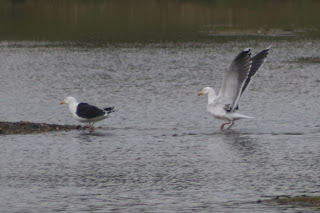
Charlie and I had a meeting with the bird group executive committee members late morning. On route to the office to prep for the meeting I had 2 adult Great Black-backed Gulls drop in on Phase 1 Wet Grassland (the first ones since 21st January) and a Greenshank fly about calling. Glenn and Steve Thomas were on the mound and had already had it. So a decent start to the day, but one that went downhill for me once I got to the office. Glenn and Steve went on to get 2 Ringed Plovers fly north east, a Redshank over and four minutes later a Spotted Redshank circling before heading off east. Ouch! Spotted Redshank would have been a patch tick for me (I have had 5 patch ticks already this year and this was the first one I have missed). It was clearly an extremely good wader day. Days such as this are becoming less frequent here and I was stuck in the office prepping for a meeting. They went on to get 2 Whimbrel flying west 10 minutes after the Spotted Redshank. Because they were going in the opposite direction to everything else I just about managed to get on them as they disappeared into the distance. 25 minutes later and Steve was now heading towards the office ready for the start of the meeting. Glenn got a Golden Plover flying south, which was shortly followed by a Corn Bunting - the latter of which has become a Beddington mega and one that Steve has never seen on patch before. To top off his day Glenn saw a White Stork flying south east over in the direction of Croydon, which Dave, Ian and Nick also managed to see. So overall an incredible day for the Farmlands!
 |
| Adult Great Black-backed Gulls |
 |
| Male Grey Wagtail |
28th April:
A relatively slow day. The highlight bird was not even narrowed down to a definite species! As I was looking at the female Peregrine through my binoculars I got onto a Tern flying behind it in the distance. It was flying west and away from myself, my mum and Glenn. I failed to get them onto it and with the poor views I got of it I had to stick it down as a Common or Arctic Tern, also referred to as a 'Commic' Tern.
29th April:
Another 70 species day. eBird list
here.
 |
| Hobby |
30th April:
A Greenshank and smart male and female White Wagtail were the highlights.
Sunrise above and below
 |
| Greenshank |
 |
| Phonescoped male White Wagtail |
 |
| Speckled Wood Butterfly |
Mating Green-veined White Butterflies above and below


